
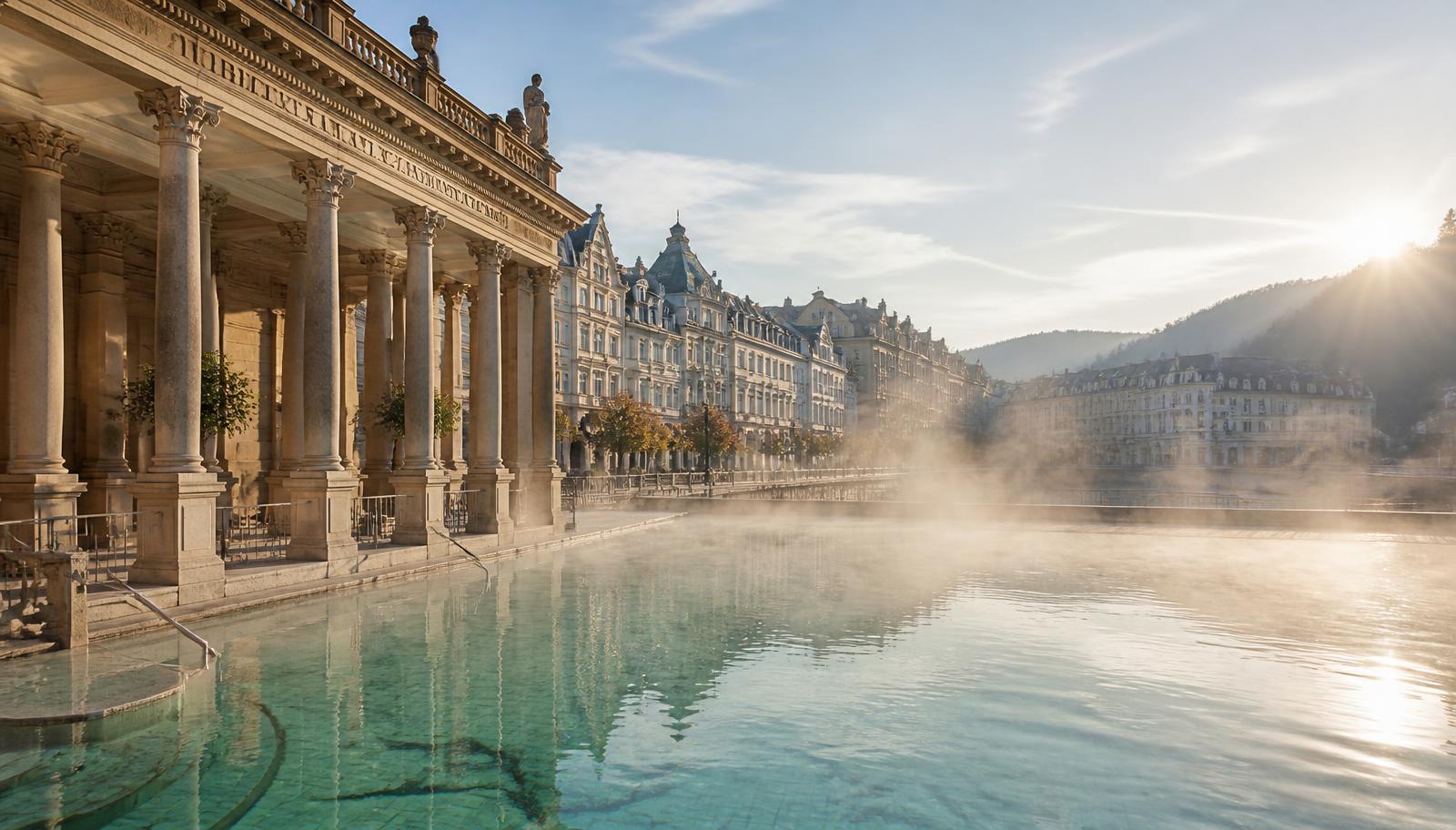
Guide CXXXIII — Wellness — Europe
Europe's Spa Towns: Baden-Baden to Budapest, and What a Cure Costs Now
The thermal towns Europe built for the cure — Baden-Baden, Bath, Vichy, Karlovy Vary, Budapest, Bad Ragaz and Montecatini — compared on water, season, rates and how long to stay.
The short answer
Europe's spa towns are the oldest wellness inventory in the world and the least fashionable, which is exactly why they work. Eleven of them carry a joint UNESCO listing, and most still run on mineral water drawn from the ground rather than on a treatment menu written by a brand consultant. You go for a week, you drink or bathe in water with a chemistry certificate, you walk, you eat less, and something shifts.
The difference from Asia is structural. A Bali retreat sells a programme; a Japanese onsen sells a ritual; a European spa town sells a medically supervised routine wrapped in a nineteenth-century town you can walk out into. That last part matters — nobody is stranded on a clifftop with a juice.
The rest of the wellness cluster:
Seven towns, honestly compared
Pick by what the water is for and how much town you want around it. Rates below are indicative for a good room or a whole apartment in season.
| Town | Country | What the water is for | Indicative nightly | Best months |
|---|---|---|---|---|
| Baden-Baden | Germany | Thermal bathing, classic Kur, cardiology | $550–$1,600 | May–June, September |
| Bath | United Kingdom | Rooftop thermal bathing, short breaks | $500–$1,400 | May, September–October |
| Vichy | France | Drinking cure, digestion, thermal showers | $500–$1,100 | May–September |
| Karlovy Vary | Czechia | Drinking cure, digestive and metabolic | $500–$1,200 | May–June, September |
| Budapest | Hungary | Thermal bathing, rheumatology, city stay | $500–$1,300 | April–May, September–October |
| Bad Ragaz | Switzerland | Medical rehabilitation, orthopaedics | $900–$2,800 | June–September |
| Montecatini Terme | Italy | Drinking cure, liver and digestion | $500–$1,000 | May–June, September |
What a cure actually involves
Seven nights is the floor
Thermal medicine is dose-based. Two nights buys you a nice bath; the traditional prescription is two to three weeks and the modern compromise is seven to ten nights. Book fewer and treat it as a break, not a cure.
A medical intake, not a spa menu
At Baden-Baden, Bad Ragaz, Karlovy Vary and Vichy the serious programmes start with a doctor's consultation and bloods, then a prescribed schedule of baths, drinking, massage and exercise. Expect $250–$900 on top of the room, per person, for the medical package.
The town is the treatment
Colonnades, parks and graded walking routes are not decoration — they were designed as part of the cure. Choose a town you would happily walk around twice a day in silence.
Where you stay
Grand hotels hold the treatment contracts; private apartments and houses give you space, a kitchen and quiet. Many guests take the apartment and buy the clinic programme separately, which is usually cheaper and always calmer.
How it compares with Japan and Bali
| Japan onsen | Bali retreat | Europe spa town | |
|---|---|---|---|
| The core | Hot-spring bathing ritual | Programme: yoga, detox, therapy | Mineral water under medical supervision |
| Typical stay | 2–4 nights | 5–14 nights | 7–14 nights |
| Indicative nightly | $500–$2,600 | $500–$2,000 | $500–$2,800 |
| Best months | Nov–Feb, Oct maples | May–Sept dry season | May–June, September |
| Go if you want | Silence, heat, kaiseki | Structure and a teacher | A routine and a real town |
Booking checklist
- Decide bathing or drinking cure — it changes the town.
- Block seven nights minimum; ten if you want the effect to hold.
- Book the medical programme before the room; clinic slots run out first.
- Ask whether the hotel has its own thermal source or buses you to the baths.
- Avoid German and Italian public-holiday weeks unless you like queues.
- Take a house or apartment if you are two couples or travelling with staff.
Plan the trip:
Frequently asked questions
- Which European spa town is best for a first visit?
- Baden-Baden. It has the best combination of serious thermal bathing, medical programmes, walkable town and good food, and it is two hours from Frankfurt or Zurich. Bath is the easiest for a short English-speaking break; Bad Ragaz is the one to choose if the trip is genuinely medical.
- How much does a week in a European spa town cost?
- Budget $500–$1,600 a night for the room or apartment in most towns, $900–$2,800 in Bad Ragaz, plus $250–$900 per person for a medical programme. A comfortable week for two lands between $6,000 and $15,000 before flights.
- When is the best time to visit Europe's spa towns?
- May, June and September are the best balance of weather, open programmes and walkable parks. November and late January are the cheapest and quietest, and thermal bathing is arguably better in the cold.
- Are the spa towns suitable if I only want to relax?
- Yes — the medical route is optional everywhere. Budapest and Bath in particular work as ordinary city stays with exceptional bathing attached.
Editorial note & limitations
Nightly rates are indicative for a whole-house booking or a ryokan room with a private bath, and move with the calendar. Hotels, ryokan, spa hotels and other rentals shown on the listings pages are searched live through our booking partners; nothing here is a sponsored placement.